As AI agents become increasingly capable, agent-driven robotic control is emerging as a
compelling paradigm. However, prevailing vision-language-action (VLA) models and
world action models (WAMs) still rely on natural-language instructions to specify
manipulation tasks, an ill-suited interface for agent-driven control: referentially
ambiguous, spatially imprecise, redundant with the agent’s inherent language
understanding, and entangling intent with execution.
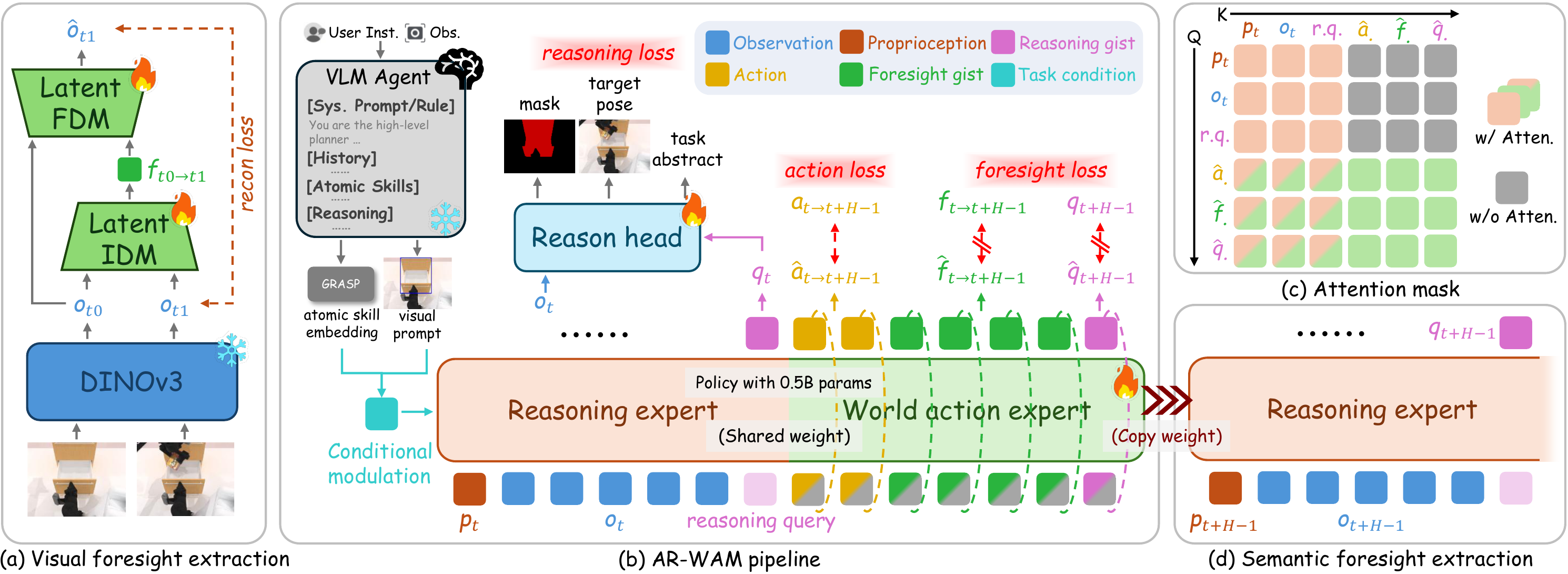
We present AR-WAM, a visual-conditioned, agent-ready world action model that replaces
language with two complementary conditions: a visual grounding prompt (a bounding
box of the target) denoting the interaction object and location, and a learnable
operation token dictating the atomic skill to execute. Our compact 0.5B-parameter
model, with a frozen pretrained visual encoder and no language encoder, predicts scene
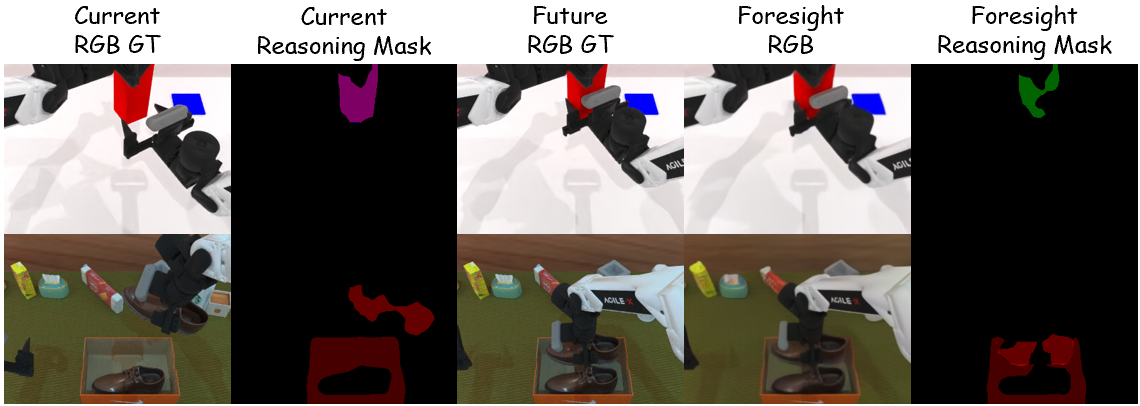
evolution within compact latent states while decoding actions, exposing the policy’s
intent through explicit, supervisable reasoning signals. A model-agnostic compatibility
layer provides three primitives (detect, execute, and query) so that local VLMs or
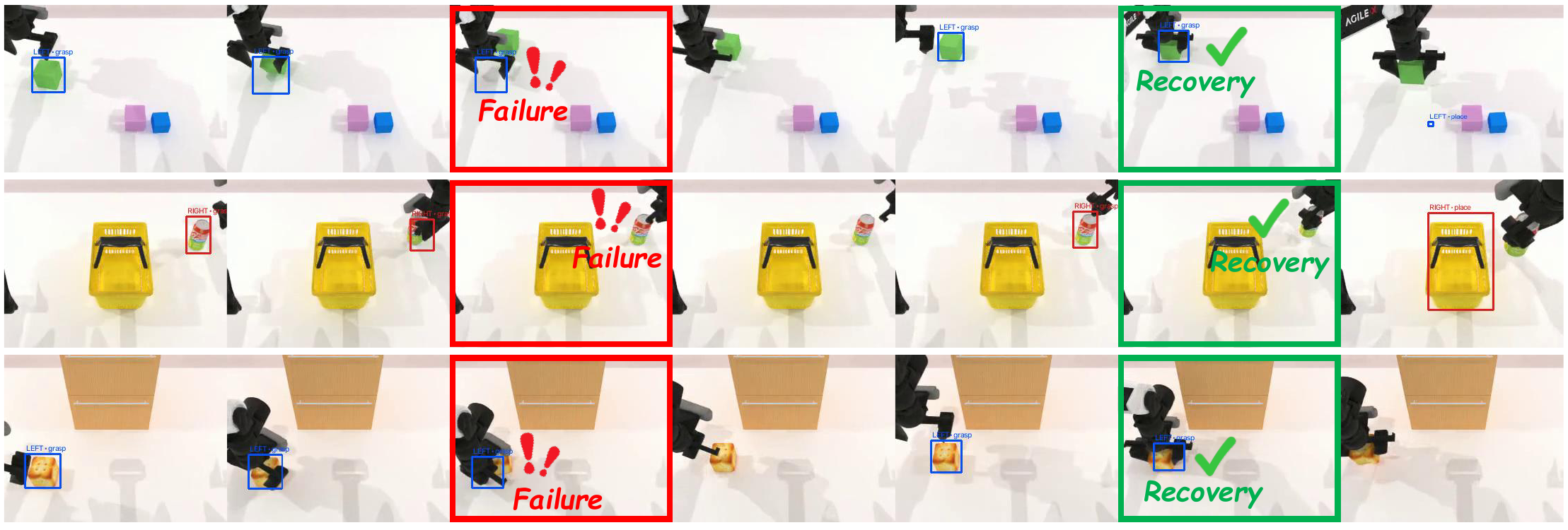
online agent APIs can drive the policy directly, with long-horizon memory and
closed-loop error recovery delegated to the agent side.
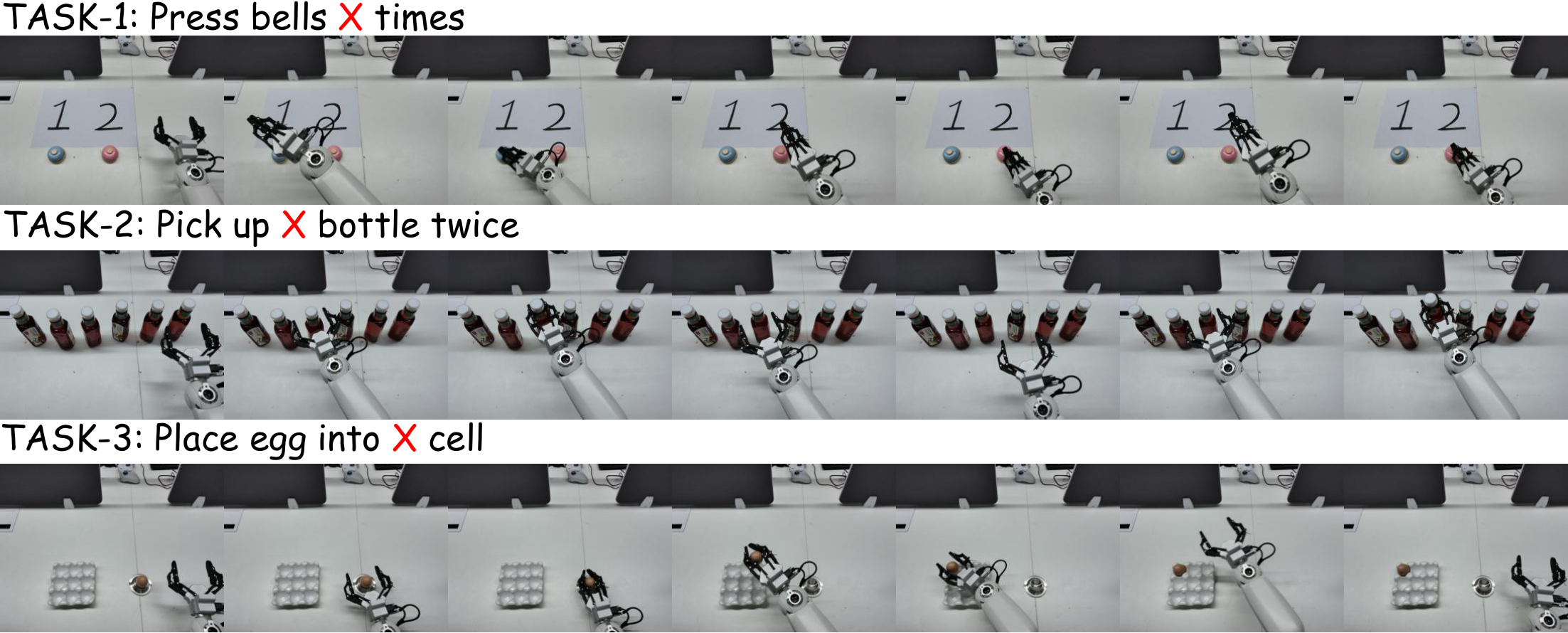
On RoboTwin 2.0, RMBench, and a real Astribot S1 dual-arm platform, AR-WAM matches the
strongest baselines on standard manipulation (87.2% average success) and outperforms them
on memory-dependent and real-robot long-horizon tasks, improving success rates by 5.9%
and 36.7%, respectively, while maintaining the lowest inference latency (14.1 ms).